The rupee-dollar exchange rate affects gold prices in India by influencing the cost of imported gold in the domestic market. As a result, currency movements are often closely watched by buyers, investors, and borrowers who are tracking the ongoing gold rate.
This blog explores the key factors influencing the rupee-dollar exchange rate and explains how currency movements shape gold prices in India.
Factors That Affect the Rupee Dollar Exchange Rate and Gold Prices in India
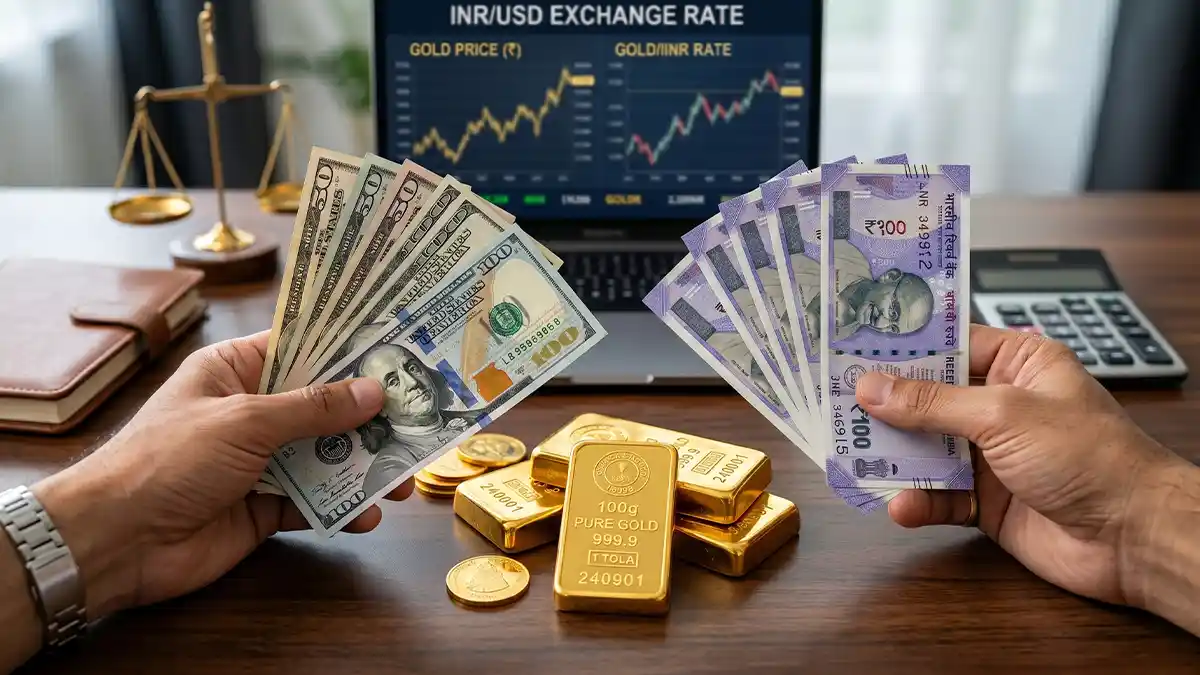
From the US Federal Reserve policy to geopolitical developments, several factors influence gold prices. Understanding them can help buyers and investors make more informed financial decisions. These include:
US Federal Reserve Policy
When the Federal Reserve raises interest rates, gold prices tend to fall as investors shift towards interest-bearing assets. When rates drop, gold prices often rise as investors seek protection against inflation.
For Indian buyers, the impact goes further: higher US interest rates attract investors to shift funds from emerging markets to the US. This puts pressure on the rupee and simultaneously raises the domestic cost of gold imports.
India’s Trade Deficit
A trade deficit occurs when a country imports more than it exports. In India, a sharp increase in gold imports can contribute to this imbalance because gold purchases from international markets are paid for in US dollars.
As importers buy more dollars to pay for gold, demand for the US currency rises, which can put pressure on the rupee. As a result, gold prices in India can rise even when international gold prices remain unchanged.
For example: If 1 USD = 93 INR and gold costs 1,000 USD, the gold price in India is about 93,000 INR. If the rupee weakens to 95 INR per USD, the same gold costs 95,000 INR, even if the global gold price has not changed.
Inflation Differentials Between India and the US
When inflation in India remains consistently higher than inflation in the US, the rupee can gradually lose value against the dollar over time. This is because higher inflation reduces the purchasing power of a currency and can make it less attractive to investors.
A weaker rupee increases the cost of importing gold, which can push gold prices higher in India. At the same time, many investors turn to gold as a hedge against inflation, increasing demand, and further supporting gold prices.
Influence of Taxes and Other Costs
Customs duty and GST are applied to the rupee value of imported gold. When the rupee weakens, the base gold price rises, increasing the taxes charged and pushing retail prices higher. While making charges and local margins matter, the base gold price is determined by converting the international gold price from US dollars into rupees.
Geopolitical Conditions
Global conflicts and political instability push investors worldwide towards safe-haven assets, and gold sits at the top of that list. Economic uncertainty caused by conflicts leads to increased gold purchases, which pushes gold prices higher. For Indian buyers, this global rush carries a currency dimension as well.
Geopolitical tensions may also raise crude oil prices. Since crude oil is also primarily priced in US dollars in international markets, Indian importers must first purchase dollars to pay overseas suppliers. Basically, when oil prices rise, India needs more dollars to buy the same quantity of oil, increasing demand for the US currency. This can put downward pressure on the rupee, making imported gold more expensive for Indian buyers.
Also Read: Gold Price Patterns in India: Seasonal Trends and Historical Analysis
Understanding the Rupee-Dollar Exchange Rate’s Effect on Gold
Major commodity exchanges, central banks, mining companies, and bullion dealers use the US dollar as the standard currency for gold transactions. This is why the rupee-dollar exchange rate plays a role in shaping gold prices in India. To put it simply, a weakening rupee pushes gold prices in India higher, whilst a stronger rupee offers buyers some relief at the counter.
This exchange-rate effect matters even more because India is one of the world’s largest gold importers. The country’s gold imports reached $58 billion in FY 2024-25, rising sharply from $45.54 billion the year before, cementing gold’s place as one of India’s largest import items after crude oil and electronics.
The currency link becomes clearer when one compares gold’s performance in dollar terms versus rupee terms over recent years. Over the past five years, the Indian rupee has depreciated steadily at an average annual rate of approximately 3.9% against the US dollar. Domestic gold prices have consistently outpaced global gold prices, as each dollar spent on imports converts into progressively more rupees.
Also Read: International Gold Market Price: Worldwide Rates & Latest Trends
To Conclude
The rupee-dollar exchange rate remains an important factor in determining gold prices in India, influencing everything from import costs and market demand to investor sentiment. By understanding how currency movements interact with global and domestic economic factors, buyers can make more informed decisions.
For those looking to unlock the value of their gold assets, a Gold Loan from Poonawalla Fincorp can offer a convenient way to access funds when needed.
Frequently Asked Questions
What happens to gold prices in India when the rupee falls against the dollar?
When the rupee weakens against the US dollar, gold prices in India generally rise because imported gold becomes more expensive in rupee terms. Since India relies heavily on gold imports, a weaker rupee increases the domestic cost of gold.
Does the gold price rise when the US dollar weakens?
Yes, global gold prices can rise when the US dollar weakens. Since gold is priced internationally in US dollars, a weaker dollar makes gold more affordable for buyers using other currencies. This can increase global demand for gold and push prices higher. However, the US dollar is not the only factor. Gold prices are also influenced by inflation, interest rates, geopolitical uncertainty, and overall market sentiment.
What factors decide the gold rate in India?
The gold rate in India reflects a combination of international spot prices, the prevailing rupee-dollar exchange rate, and local demand and supply conditions. In practice, jewellers base their daily pricing on rates published by the local Gold Jewellers’ Association each morning.
Which months offer the cheapest gold prices in India?
Gold tends to be most affordable in India during June and July. Demand eases during this period as the wedding season winds down and major festivals remain months away, prompting jewellers to offer better pricing and reduced making charges to move inventory.
We take utmost care to provide information based on internal data and reliable sources. However, this article and associated web pages provide generic information for reference purposes only. Readers must make an informed decision by reviewing the products offered and the terms and conditions. Loan disbursal is at the sole discretion of Poonawalla Fincorp.
*Terms and Conditions apply